Industrial Mixer Repair for Chemical Mixers and Agitators
February 4, 2026·By Nolan Watson
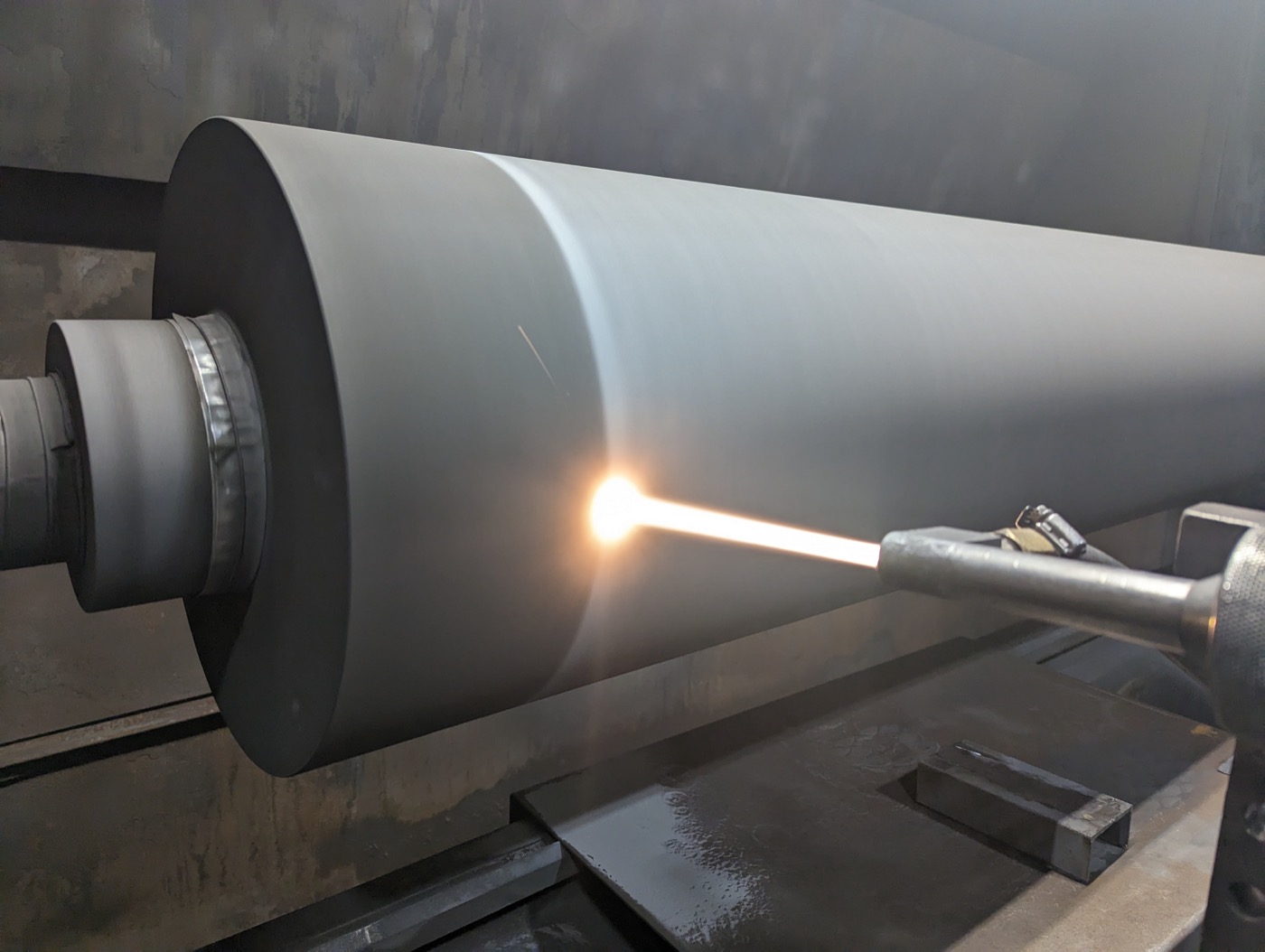
Industrial mixer repair for chemical processing plants has to account for corrosive chemistries, abrasive media, heat, and continuous operation. Chemical mixer repair and agitator repair are not simply about restoring dimensions. The work has to improve reliability, maintain tight tolerances, and perform in a specific chemical environment. That's where a turnkey, after-market approach matters.
One-Source Reliability for the Chemical Processing Industry
For over 70 years, HFW Industries has supported chemical processors with integrated manufacturing and repair solutions for critical rotating equipment. Our one-source reliability model combines:
- Thermal spray coatings
- Hardfacing weld overlays
- Precision CNC machining
- Grinding and finishing
- Inspection and final assembly
This allows us to move quickly, control quality at every step, and engineer repairs around how the equipment actually operates.
How Chemical Mixers and Agitators Fail
Common failure modes are corrosion and wear, potentially both at the same time. The base material may be sound, but prolonged exposure to aggressive chemistry gradually degrades working surfaces, shaft journals, and interfaces. Common base materials we encounter include:
- Stainless steels (common for mixer shafts)
- Super duplex stainless steels
- Hastelloy® and Inconel® (application-dependent)
Material selection alone rarely solves the problem. Performance depends on how the surface interacts with the process chemistry, which is why surface engineering plays such a critical role in long-term reliability.
Choosing the Right Repair Strategy for Chemical Service
Every repair starts with understanding the application. Chemical environments vary widely, and customers are understandably guarded about process details. As a result, there is no universal solution, only informed engineering choices.
Machining Alone
Used when wear is minimal and the base material remains suitable for service.
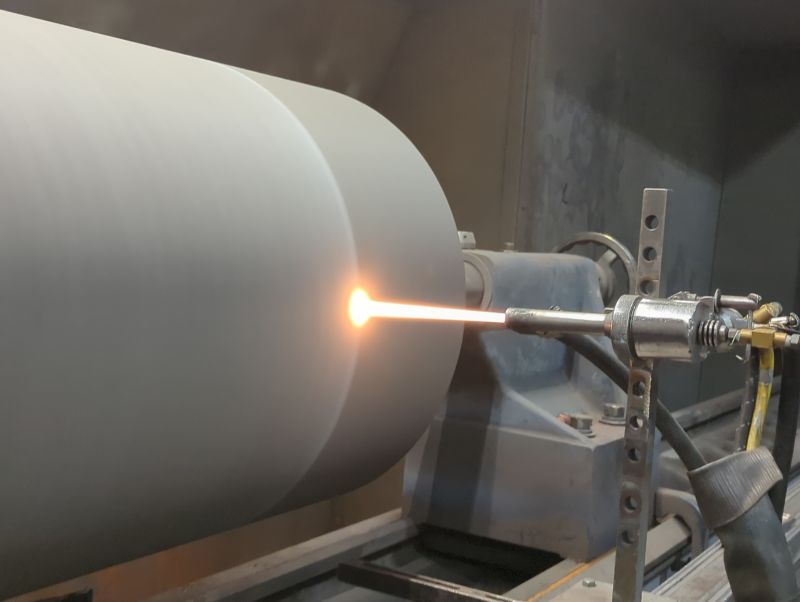
Thermal Spray
Ideal when minimal heat input is required and no major dimensional restoration is needed.
- Mechanically bonded coating
- Typical finished thickness: ~0.010-0.050 in
- Used where corrosion and moderate wear are primary concerns
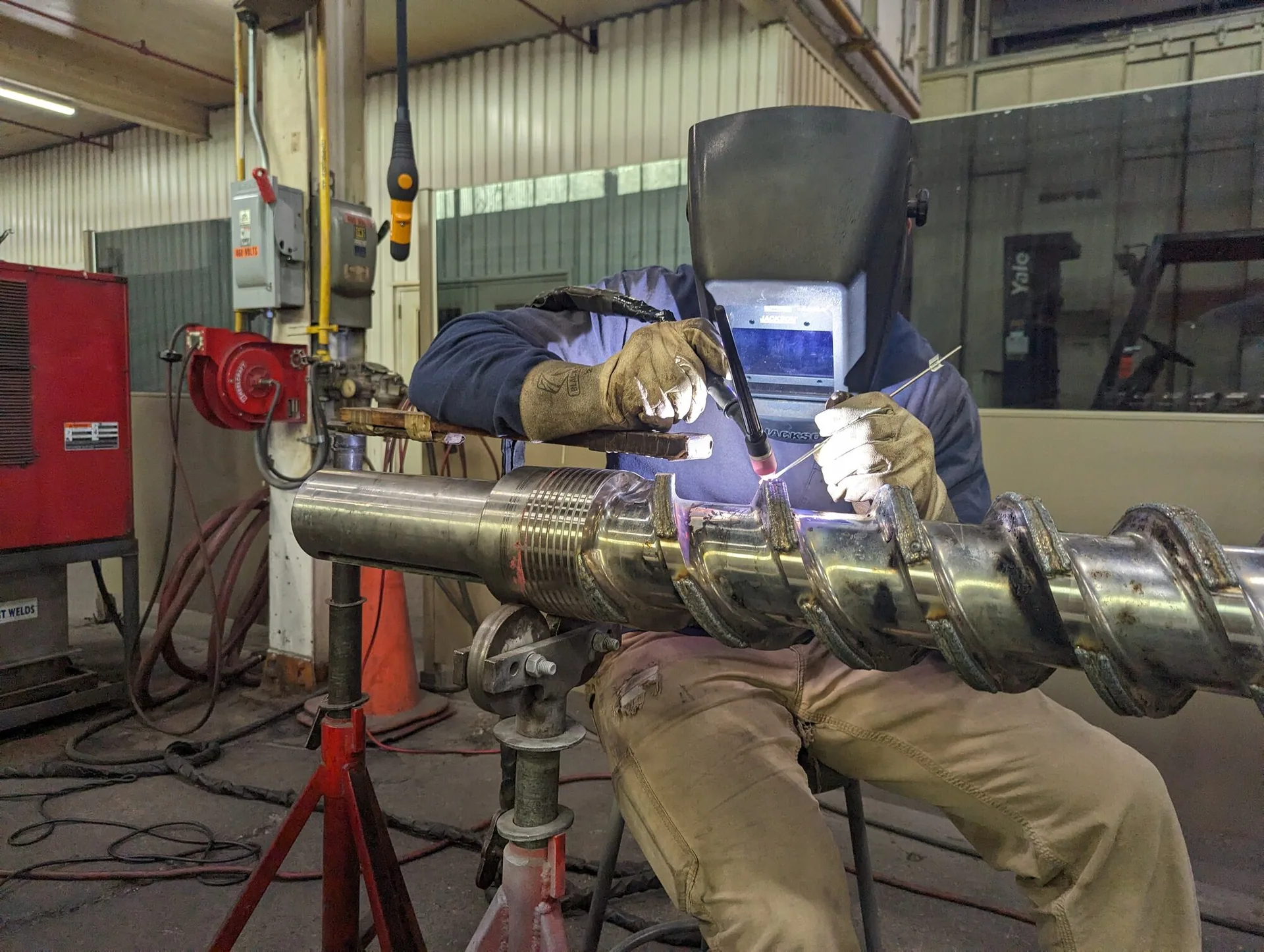
Hardfacing Weld Overlays
Selected for severe operating environments where impact, heavy wear, or aggressive corrosion demand a metallurgical bond.
- Higher heat input
- Suitable for heavier-duty components
- Allows significant profile restoration (e.g., mixer screws and paddles)
Chemical compatibility is evaluated before selecting a coating or overlay. What performs well in one process may fail prematurely in another.
Proprietary Materials: Where HFW 512 Fits
HFW 512 is a proprietary nickel-based alloy thermal spray material developed for environments involving corrosion with some wear. In certain chemical applications, it has delivered significant service life improvements compared to ceramic coatings or some nickel-based alloys. Its success depends on the specific chemistry, operating conditions, and failure mechanisms involved. When another material is better suited, HFW recommends alternatives based on experience and data.
Precision Matters: Tolerances & Quality
Chemical mixers and agitators demand precision to operate reliably. HFW regularly works to tight dimensional and runout requirements, including:
- Typical shaft tolerances: 0.0005″
- Tighter tolerances down to 0.0002″ TIR when geometry allows
Quality control measures are selected based on the repair scope and risk profile and may include:
- Liquid penetrant inspection of weld overlays
- Runout, straightness, and concentricity verification
The goal is repeatable, predictable performance in service.
Short Lead Times for Chemical Processors Without Cutting Corners
Because coating, welding, precision machining, precision grinding, and inspection are all in-house specialties, HFW is able to support short lead times, including emergency repairs, while keeping the work under one quality system. This integrated execution reduces handoffs and keeps accountability clear, especially important when downtime is costly.
Experience That Shows in the Results
HFW's long-standing relationships in the chemical processing industry are built on practical repair work for real operating conditions. Whether restoring mixer shafts, rebuilding agitator assemblies, or applying advanced surface solutions, our focus remains the same: reliability you can plan around.
Contact HFW Industries for Chemical Equipment Repairs
To discuss your application, email RFQ@hfwindustries.com. Submit a quote request with drawings, photos, operating conditions, and timing so HFW can review the application and next steps. You can also call (716) 875-3380.
About the Author
Nolan Watson writes about reliability, rebuild strategies, industrial manufacturing trends, thermal spray coatings, and precision grinding at HFW Industries.
Additional Technical Resources for Chemical Processing Professionals
- Corrosion-Resistant and Chemical-Resistant Coatings
HFW's full scope of repair services for chemical processing components including shafts, housings, and mixers.
- HFW 512 Corrosion-Resistant Coating Case Study
How HFW 512 corrosion-resistant coating helped extend chemical processing roll life from months to years.
- HVOF Tungsten Carbide Coating Properties
Material properties, hardness, and wear resistance data for HVOF-applied tungsten carbide coatings.
- Wear-Resistant Coatings for Industrial Equipment
How HFW evaluates wear-resistant coatings for abrasion, erosion, galling, corrosion with wear, and related service conditions.
- Custom Machining and Welding for Chemical Equipment Repair
How HFW's custom machining and welding capabilities support complex chemical equipment repair and fabrication.
- Repair vs. Replace: When Remanufacturing Beats Buying New
Framework for evaluating whether to repair or replace worn equipment, with cost and lifecycle considerations.
Frequently Asked Questions About Chemical Mixer & Agitator Repair
What causes chemical mixers and agitators to fail in chemical processing plants?
Common failure modes are corrosion and wear, potentially both at the same time. Even when the base material remains structurally sound, aggressive chemistries, abrasive media, heat, and continuous operation gradually degrade shafts, journals, screws, and interfaces.
What materials are commonly used for mixer and agitator shafts in chemical processing?
Many mixer and agitator shafts in chemical service are made from stainless steel, though super duplex stainless steels, Hastelloy®, and Inconel® are also used depending on the chemical environment. Material selection alone rarely solves reliability issues. Surface condition and chemistry compatibility are critical.
Can HFW support industrial mixer seal repair?
Yes. HFW can evaluate worn mixer and agitator features including shaft journals, seal areas, bearing areas, screws, paddles, and interfaces. Repair may involve machining, thermal spray coatings, hardfacing, grinding, and inspection depending on the condition and operating environment.
What is HFW 512, and when is it used?
HFW 512 is a proprietary nickel-based alloy thermal spray material developed for environments involving corrosion with some wear. In one documented chemical processing application, standard thermal spray and HFW 512 together produced a 30× increase in component lifespan. However, HFW 512 is not a blanket solution and is applied only when the chemistry and operating conditions support it.
Why does a turnkey, one-source approach matter for chemical equipment repair?
A turnkey, one-source approach reduces vendor handoffs, shortens lead times, improves quality control, and keeps accountability clear. By performing coating, welding, machining, grinding, inspection, and assembly in-house, repairs are engineered around how the equipment actually operates.
Attribution Statements
- Hastelloy® is a registered trademark of HAYNES INTERNATIONAL, INC.
- Inconel® is a registered trademark of HUNTINGTON ALLOYS CORPORATION.
Stay Informed
Subscribe to Our Newsletter
Get practical insights from HFW’s turnkey manufacturing and rebuild team to help you extend equipment life, reduce downtime, and simplify your next equipment project.


Unsubscribe anytime. Open signup directly.