Thermal Spray Coating Services
Wear and corrosion are a persistent threat to precision industrial equipment. At HFW Industries, thermal spray coating services are a core competency developed over 75 years. In fact, HFW was the first commercial licensee of the Rokide® ceramic spray process in 1956. We apply HVOF, plasma spray, and metallizing thermal spray coatings to protect new components and restore worn ones to OEM spec. HFW serves power generation, oil & gas, chemical processing & plastics, mining & extraction, and high-tech manufacturing, all from one ISO 9001:2015 certified facility that handles coating, hardfacing, precision machining, precision grinding, and inspection.
Request a Quote
Take a Look Inside Our Plant: Thermal Spray Gallery
At HFW Industries, precision and performance drive everything we do. Our thermal spray technologies—including plasma spray, high velocity oxy-fuel (HVOF), and electric arc metallizing—enhance component durability, reduce downtime, and extend equipment life across a wide range of industries.
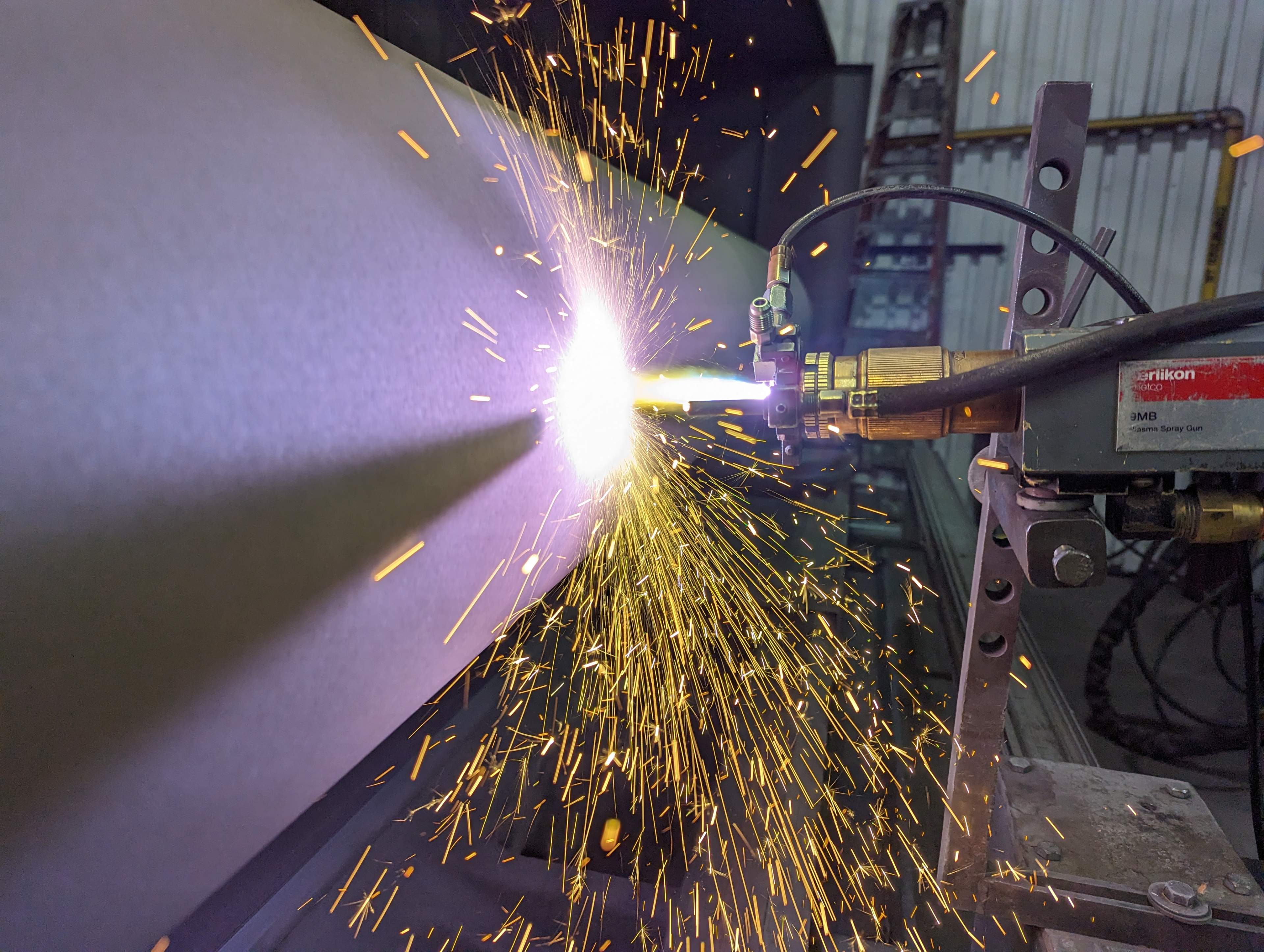
Plasma Spray
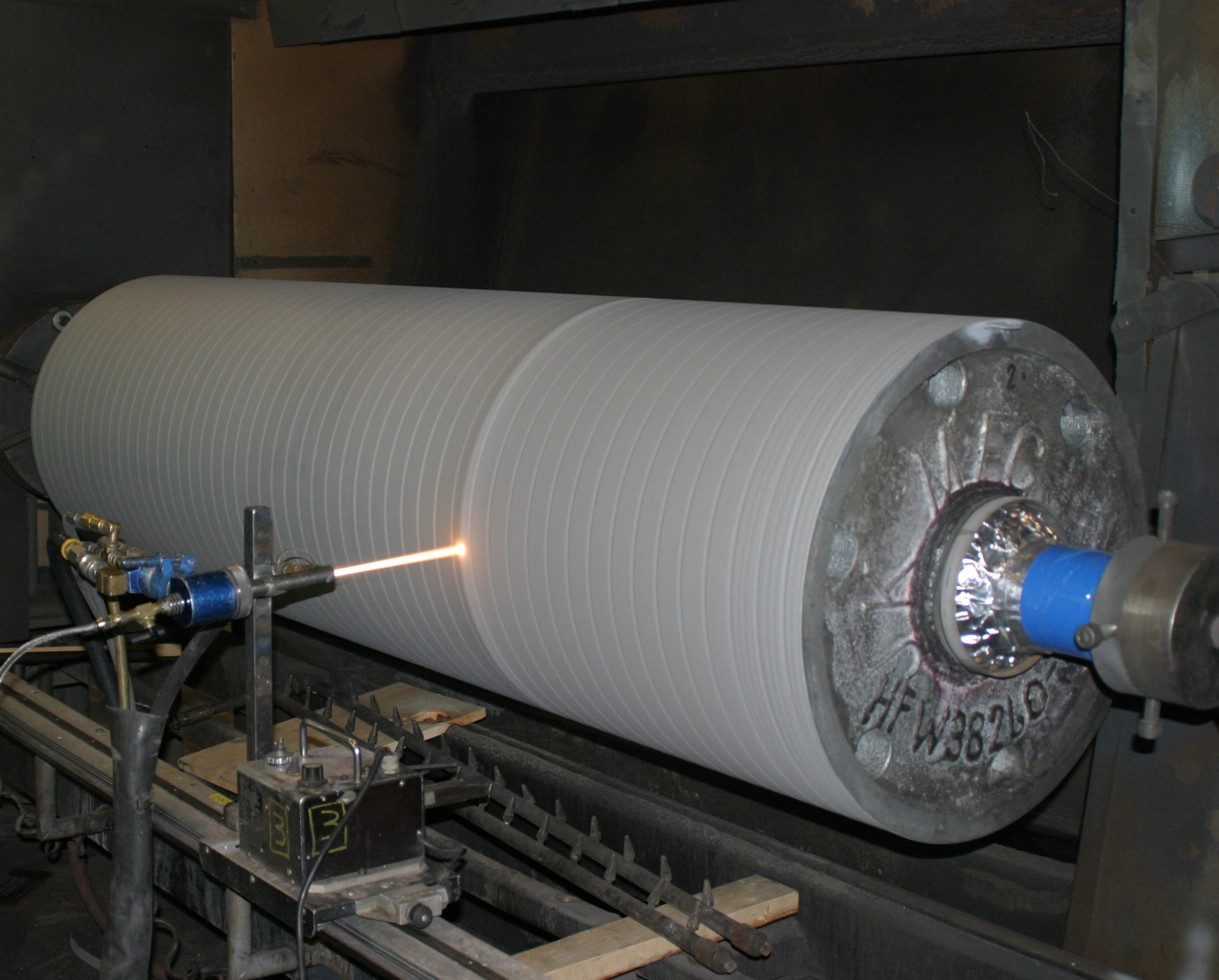
HVOF
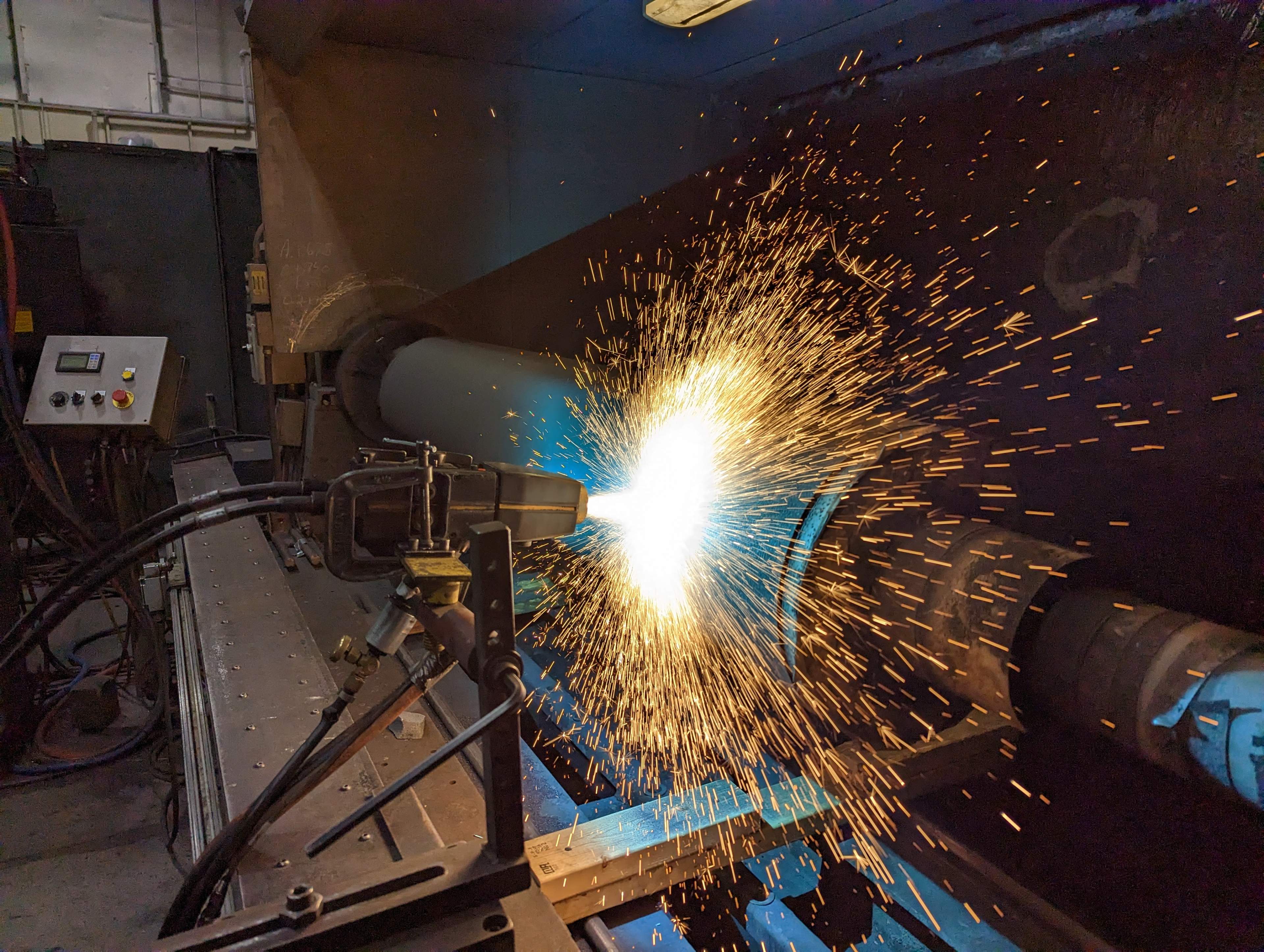
Electric Arc Metallizing
Thermal Spray At a Glance
- Processes: Flame spray, electric arc wire spray, plasma spray, HVOF, Rokide flame spray (ceramic rod), and spray welding
- Materials: Tungsten carbide, chrome carbide, tungsten carbide nickel, nickel-based alloys, proprietary HFW 512, and various others
- Tolerances: Machined and ground to tolerances as tight as 0.0002". Electrical mechanical runout (EMRO) measurements are available when needed
- Track record: HVOF offered for 30+ years; documented case of 30x service life extension
- Facility: ISO 9001:2015 certified; coating, hardfacing, precision machining, precision grinding, and inspection in one Buffalo, NY plant
- Industries:Power generation & turbomachinery, oil & gas, chemical processing & plastics, mining & extraction, high-tech
HFW 512: Years of Additional Service Life
A chemical processing customer came to HFW with rolls failing after just two months in service. Standard thermal spray coating got that to 4 to 5 months. HFW then developed HFW 512, a proprietary nickel-based alloy applied via HVOF, working directly with the customer's metallurgist.
Result: roll lifespan increased from months to 5 to 6 years in service, a result now backed by more than 40 years of documented performance data.
HFW 512 is built for corrosion with some wear. For plant managers and procurement teams, that means fewer shutdowns, less unplanned maintenance, and a lower total cost of ownership. When it doesn't fit, we'll tell you and recommend the coating that does.
Facing a similar wear or corrosion problem?
📧 RFQ@hfwindustries.com | 📞 (716) 875-3380
Why Reliability Engineers and Procurement Teams Choose HFW
- One source, not five vendors. Coating, machining, hardfacing, grinding, and inspection happen in one facility, so tolerance stacking and vendor handoffs don't eat your timeline.
- Engineering-led material selection. We match the coating to your operating temperature, wear/corrosion balance, and chemistry, and we'll recommend a standard coating over a proprietary one when that's the better call.
- Tight tolerances, verified. Grinding to 0.0002" tolerances. When needed, electrical mechanical runout (EMRO) inspection is provided before a part ships.
- A track record you can check. 30+ years running HVOF and ISO 9001:2015 certified.
- Built for planned outages and emergencies. Short lead times without cutting corners on quality control.
Thermal Spray Coatings for Power Generation
HFW has served the power generation industry for 75+ years, combining thermal spray coatings and weld overlays with in-house CNC machining, precision grinding, and assembly. That range lets us address abrasion, wear, loss of profile, erosion, and corrosion without sending a component to a separate shop for finishing.
Coating performance for power generation applications is measured, not assumed. Typical HVOF tungsten carbide coatings applied at HFW carry a microhardness of 1,000 to 1,350 DPH, bond strength over 10,500 PSI per ASTM C633, porosity under 1 percent, and an estimated maximum service temperature of 1,000°F. As-sprayed surface roughness runs 150 to 250 Ra, and finished parts can be ground down to 1 to 5 Ra.
HFW can manufacture and repair various pieces of precision industrial equipment for power generation, including:
- Turbine and turbo-compressor shafts
- Rotor assemblies
- Shaft sleeves and seal housings
- Bearing housings and balance pistons
- Valve components, bushings, couplings, and gearbox bores
- Inlet pipes and steam path components for turbine and generator systems.
Our thermal spray coating services can support several in-demand turbomachinery applications, including steam turbine repair, gas turbine blade repair, and turbine rotor repair, without outsourcing any step of the process.
For a worn shaft or housing, we rebuild diameters, apply HVOF coatings like tungsten carbide or chrome carbide, and return the part to OEM specification or better, verified by EMRO inspection down to 0.0002". Read HFW's take on the tungsten carbide shortage in 2026 and potential alternatives.
Need a coating solution for a turbine, generator, or steam path component?
📧 RFQ@hfwindustries.com | 📞 (716) 875-3380
Thermal Spray Coatings for Chemical Processing
HFW has supported chemical processing equipment for 75+ years, combining thermal spray coatings and hardfacing weld overlays with precision machining and grinding in one facility. That track record includes the HFW 512 case study above, where a proprietary alloy took a chemical processing customer from months between roll replacements to years.
Chemical processing components that HFW can manufacture and repair include:
- Valve guides, valve bodies and stems, gate valves, and diverter valves
- Rolls, including feed rolls, idler rolls, godet rolls, calendar rolls, nip rolls, steam rolls, and dryer rolls
- Mixer components, including paddles in Hastelloy®, Stellite®, or stainless steel, along with shafts and shaft sleeves
- Reactor shafts, pump shafts, and agitator shafts and assemblies
- Bearing and seal housings, and pump housings and components
- Centrifuge components, including screws, barrels, bowls, and bowl end flanges
Because these components run in corrosive, chemically aggressive environments, material selection matters as much as the coating process. HFW's engineering team accounts for the specific chemistry involved before recommending a chemical-resistant coating, rather than applying the same material across every application.
Have a pump, mixer, or roll that needs a corrosion-resistant coating?
📧 RFQ@hfwindustries.com | 📞 (716) 875-3380
Coating Processes and Materials
These are some of the thermal spray processes we run, and what each is best for:
- HVOF: Dense, low-porosity coatings for demanding wear and corrosion applications. Offered at HFW for 30+ years.
- Plasma spray: Higher-energy applications; can form an enhanced bond with the substrate.
- Metallizing / Rokide: Additional options selected based on application needs.
- Hardfacing weld overlay (PTA, Arc, TIG, MIG): Impact resistance or heavy buildup where a metallurgical bond is required instead of a mechanical one.
These are some materials we apply, and what each is best for:
- Tungsten Carbide (WC/Co): Wear protection under 1,000°F.
- Chrome Carbide (Cr3C2/NiCr): Above 1,000°F, or when corrosion and wear resistance are both critical.
- Tungsten Carbide Nickel (WC/Ni): Wear applications requiring added corrosion resistance.
- Nickel-based corrosion-resistant alloys, including HFW 512: Corrosion-dominant environments with some wear.
There's no default coating. HFW's engineering team reviews your operating temperature, wear/corrosion profile, and chemistry before recommending a process and material.
Not sure which coating fits your application?
📧 RFQ@hfwindustries.com | 📞 (716) 875-3380
Coating Performance, Engineered
A few technical factors determine how a thermal spray coating actually performs in the field:
- Bond type. Most coatings form a mechanical bond with a grit-blasted surface. Higher-energy processes like plasma and electric arc spray can add a physicochemical bond for extra strength.
- Porosity. Present in every thermal sprayed coating. It can hurt performance in chemical service by letting corrosive media reach the substrate, or help it on bearing surfaces by holding lubricant. We tailor porosity to the application.
- Thickness. Typically 0.010 to 0.050 inch, limited by internal stress rather than cost alone.
- Surface finishing. Adhesion depends on surface prep before spraying, and grinding quality after. Poor finishing can damage or unbond a coating, which is why HFW doesn't warrant coatings finished elsewhere.
For a more in-depth explanation, read our full breakdown of thermal spray coating characteristics.
What Is HVOF Thermal Spraying?
HVOF (High Velocity Oxy-Fuel) heats powdered coating material, typically tungsten carbide or a cobalt-based alloy like Stellite #6, in a high-pressure flame and propels it at supersonic speed onto a component's surface. The bond that forms is mechanical, not metallurgical, and application temperatures generally stay under 300°F, so the base metal never melts or dilutes.
That combination gives HVOF a few practical advantages over other coating methods:
- Dense, low-porosity coatings that hold up in corrosive environments
- A path around hexavalent chromium exposure, since HVOF coatings can replace hard chrome plating in many applications
- Tight control over coating thickness and material properties
- A finish that can be ground or polished to a fine tolerance, which matters for rotating equipment and other close-tolerance parts
Common materials applied via HVOF include tungsten carbide/cobalt for abrasion and erosion resistance, Stellite alloys for combined wear and corrosion protection, chromium carbide for high-temperature oxidation resistance, and nickel-based alloys such as Hastelloy and Inconel® for chemical and heat-intensive service. HFW selects the material based on the specific operating environment rather than defaulting to one coating for every job.
HVOF tends to be the right call when a part needs tight tolerances, a fine surface finish, and strong wear or corrosion performance without altering its underlying structure, which is why it shows up so often on rolls, shafts, and other high-speed rotating equipment.
Why HVOF Beats Hard Chrome
Hard chrome plating has gotten harder and more expensive to source as environmental regulation tightens. HVOF is a proven substitute, backed by independent testing beyond HFW's own track record. A Department of Defense task force found that WC-Co coatings last at least two to three times longer than hard chrome in fatigue, corrosion, and leakage testing of aerospace components. Read our full breakdown of the advantages HVOF thermal spraying holds over hard chrome plating.
HFW offers tungsten carbide, chrome carbide, tungsten carbide nickel, and nickel-based corrosion-resistant alloys as chrome replacements, in addition to proprietary coatings like HFW 512.
Ready to Discuss Your Coating Needs?
Whether it's a single shaft that needs a coating recommendation or an ongoing program to cut roll or component failures, our engineering team will review your application and recommend a process and material, not just quote whatever you ask for.
Request a Quote
📧 RFQ@hfwindustries.com | 📞 (716) 875-3380 | Contact Form
Explore Our Thermal Spray Knowledge Base
Dive deeper into the processes and real-world applications that make HFW a leader in thermal spray coating services.
- Managing the Tungsten Carbide Shortage — Learn how HFW prepared for the supply crunch and can provide alternative coatings
- Hard Chrome Plating Alternatives — Understand why HVOF coatings often outperform chrome in durability, cost, and turnaround time
- Corrosion-Resistant and Chemical-Resistant Coatings — Review the various thermal spray coating materials available for protecting precision industrial equipment from corrosion and harsh chemical environments
- What is Thermal Spraying? — Read a beginner-friendly overview of the process and materials used
- Thermal Spray Coating Characteristics — Understand how porosity, thickness, hardness, adhesion, and surface finish all impact thermal spray coatings
- Precision Grinding Services at HFW — A look inside our plant, detailing HFW's precision grinding services such as CNC grinding
- How HFW Extends Equipment Life — See a real-world example of innovation in action
- How Does HFW Serve the Turbomachinery Industry? — Learn about HFW's one-source repair and manufacturing strategy for turbines, rotors, and other turbomachinery equipment
- What is Electrical Mechanical Runout (EMRO)? — Learn how EMRO shaft inspection can help ensure operations run smoothly
- What are HFW's Hardfacing Capabilities? — Explore how HFW’s hardfacing expertise restores industrial equipment with proven weld procedures and precision inspection
Frequently Asked Questions
What is the HFW 512 coating and how does it extend equipment life?
HFW 512 is a proprietary nickel-based alloy thermal spray powder built for corrosion with some wear. In a documented chemical processing case, it extended roll service life from months to 5 to 6 years, backed by more than 40 years of performance data. HFW applies it only when the chemistry and operating conditions support it, rather than treating it as a default.
What thermal spray coating processes does HFW offer?
HVOF, plasma spray, metallizing, and Rokide, plus hardfacing weld overlay via PTA, Arc, TIG, and MIG for applications needing a metallurgical bond. Our engineering team selects the process based on your application.
What's the difference between thermal spray coatings and hardfacing?
Thermal spray coatings are mechanically bonded, use minimal heat input, and typically finish 0.010 to 0.050 inch thick. Hardfacing weld overlays use higher heat input, create a metallurgical bond, and allow heavier buildup. Thermal spray fits minimal heat input with moderate wear and corrosion; hardfacing fits severe impact, heavy wear, or aggressive corrosion.
Can HFW restore components to OEM specifications?
Yes. Grinding to 0.0002" tolerance, with EMRO inspection and TIR verification before a part returns to service.
What industries does HFW's thermal spray service support?
Power generation, turbomachinery, oil & gas, and chemical processing are core. However, our thermal spray coating services are just as applicable for protecting precision industrial equipment in mining and extraction, high-tech manufacturing, and other heavy industries.
Why choose HVOF over hard chrome plating?
DoD testing found WC-Co HVOF coatings last two to three times longer than hard chrome in fatigue, corrosion, and leakage testing, without the regulatory complications of electrolytic hard chrome. HFW has run HVOF for 30+ years.
How fast can HFW turn around a coating request?
Turnaround depends on scope, but our one-source model (coating, machining, grinding, and inspection in one facility) is built to support both planned outages and emergency requests without adding vendor delays to your timeline.
Attribution Statement
- Hastelloy® is a registered trademark of HAYNES INTERNATIONAL, INC.
- Inconel® is a registered trademark of HUNTINGTON ALLOYS CORPORATION.
- Rokide® is a registered trademark of SAINT-GOBAIN CERAMICS & PLASTICS, INC.
- Stellite® is a registered trademark of KENNAMETAL INC.