July 9, 2026Corrosion-Resistant and Chemical-Resistant Coatings
By Nolan Watson, Technical Writer at HFW Industries
Corrosion-resistant coatings help industrial components survive environments that attack the base material, whether the cause is process chemistry, high temperature, moisture, oxidation, or a combination of corrosion and wear. For maintenance and reliability teams, the goal is simple: extend service life, reduce unplanned downtime, and avoid replacing high-value parts too soon.
HFW evaluates the component, operating conditions, base material, coating history, and finishing requirements before recommending a thermal spray coating, weld overlay, or another surface engineering path. These coatings can support chemical processing, paper, power generation, oil & gas, and other industrial applications.
How Corrosion Resistance Relates to Chemical Resistance
Corrosion is a form of material attack caused by chemical or electrochemical reaction with the service environment. In that sense, corrosion resistance often falls under the broader need for chemical or environmental resistance, especially when process chemistry, moisture, oxygen, temperature, or dissolved salts are involved.
The terms are still useful because they describe different ways you may recognize the problem. Corrosion-resistant coating requests may start with metal loss, oxidation, rust, or pitting. Chemical-resistant coating requests may start with compatibility against a specific chemistry, concentration, temperature, or pH. HFW evaluates the actual failure mode so the coating is matched to the service environment, not just the label used in the RFQ.
Thermal Spray Coating Materials HFW May Evaluate
No single coating is right for every corrosive environment. HFW matches coating material, process, finishing steps, and inspection requirements to the component's actual operating conditions.
- Nickel-based alloys: often evaluated for corrosion-dominant environments, aggressive process chemistry, and applications where corrosion occurs with moderate wear.
- HFW 512: HFW's proprietary nickel-based thermal spray alloy. It has delivered major life-extension results in documented roll applications where corrosion and wear were both part of the service environment, but it is not a universal coating.
- Cobalt-based alloys: Stellite® alloys can maintain their hardness at high temperatures and can offer corrosion, abrasion, and galling resistance. HFW also has experience in preventing Stellite delamination to extend the service life of precision industrial equipment.
- Ceramic coatings: used for corrosion resistance in some applications, including cases where a hard, chemically stable surface is needed.
- Chrome carbide nickel chrome (Cr3C2-NiCr): evaluated when high-temperature wear, oxidation resistance, and corrosion resistance need to work together.
- Thermal spray aluminum: considered where environmental corrosion protection is the primary requirement.
- Hardfacing weld overlays: considered when corrosion resistance must be combined with impact resistance, heavy wear resistance, or significant profile restoration.
Examples of Corrosion-Driven Coating Work
Corrosion-driven coating work is not limited to one industry. HFW has experience evaluating coatings for dryer rolls, process rolls, pump parts, shafts, housings, power-generation components, and other high-value industrial equipment.
For example, HFW can HVOF coat turbine components for corrosion resistance when the component geometry, operating temperature, and coating material support that path. Proprietary alloys like 512 can also extend roll life in the chemical industry when corrosion and wear are both part of the service environment.
What HFW Evaluates Before Quoting
The goal is to match the coating, process, finishing steps, and inspection requirements to the component's actual operating conditions. Our team considers:
- Process chemistry, concentration, pH, temperature, and exposure time
- Whether corrosion occurs alone or alongside abrasion, erosion, galling, heat, or impact
- Base material, prior coating history, and known failure pattern
- Component geometry, coating access, thickness limits, and line-of-sight constraints
- Precision machining, precision grinding, surface finish, dimensional tolerance, and inspection requirements after coating
Contact HFW About Corrosion-Resistant Coatings
If you have machinery scheduled for repair, an upcoming outage, or questions about corrosion-resistant coatings, send us your drawing, photos, operating conditions, or failed component details. Our team can review the application as well as coating and repair/manufacture options.
To discuss your application, email RFQ@hfwindustries.com. Submit a quote request with drawings, photos, operating conditions, and timing so HFW can review the application and next steps. You can also call (716) 875-3380.
Let’s keep your equipment running and your schedule reliable.
Additional Technical Resources for Reliability and Maintenance Teams
Sign up for our newsletter and explore these resources from our Knowledge Base:
- Overview of Thermal Spray Coatings: HVOF & Tungsten Carbide — Why these materials are key to high-performance surface protection
- How HFW Extends Equipment Life — Real-world example of innovation in action: 30x increase in service life for a chemical client
- Hard Chrome Plating Alternatives — See why HVOF is the proven replacement as tightening regulations are accelerating the move away from hard chrome plating
- Managing the Tungsten Carbide Squeeze — Learn how HFW prepared for the supply crunch and can provide alternative coatings
- Reducing Assembly Time by 75% at 1/3 the Cost — Learn how HFW's one-source strategy can streamline our customer's processes and rein in costs
- How Does HFW Serve the Turbomachinery Industry? — Learn about HFW's one-source repair and manufacturing strategy for turbines, rotors, and other turbomachinery equipment
- Steam Turbine Repair — Learn about HFW's steam turbine repair services for valves, rotors, shafts, and blades, backed by a documented case where controlled hardfacing stopped delamination for at least five years.
- Precision Grinding Services at HFW — A look inside our plant, detailing HFW's precision grinding services such as CNC grinding
Attribution Statements
- Stellite® is a registered trademark of KENNAMETAL INC.
Corrosion-Resistant Coatings FAQ
What is a corrosion-resistant coating?
A corrosion-resistant coating is a surface coating selected to help protect a component from metal loss, oxidation, pitting, chemical attack, or environmental corrosion. The right coating depends on chemistry, temperature, base material, wear mode, geometry, and finish requirements.
How do corrosion resistance and chemical resistance relate?
Corrosion is driven by chemical or electrochemical reaction with the service environment, so corrosion resistance can be part of a broader chemical-resistance requirement. HFW evaluates the specific failure mode because pitting, oxidation, process-chemistry attack, and corrosion with wear may call for different coating choices.
Can HFW 512 be used for corrosion resistance?
Yes, HFW 512 can be relevant where corrosion and wear occur together and the application conditions support it. HFW evaluates the operating environment before recommending HFW 512 or another coating option.
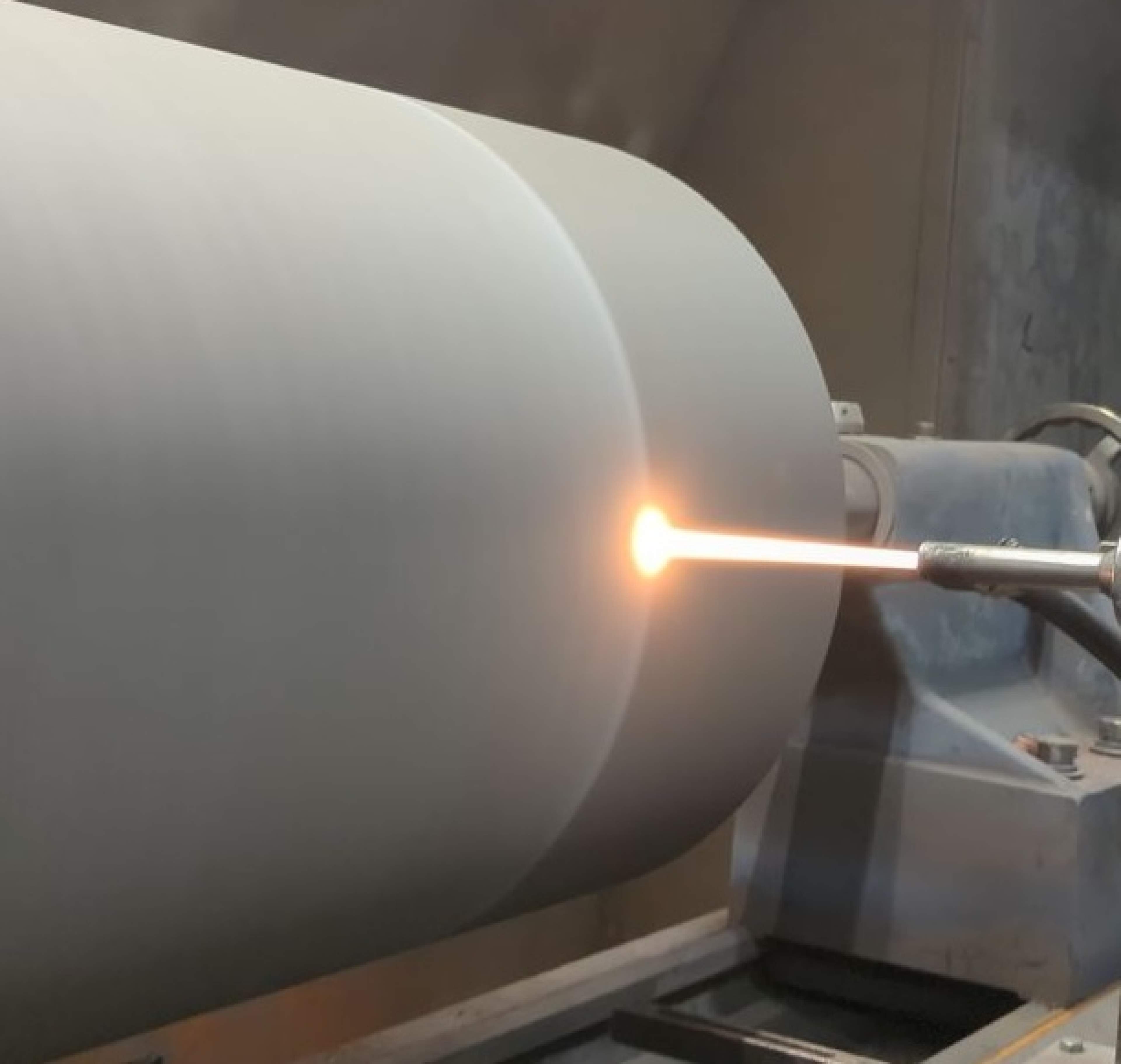
HFW applying HVOF thermal spray coating to a roll for the chemical processing industry.