October 3, 2026Ceramic Thermal Spray Coatings for Industrial Equipment
By Nolan Watson, Technical Writer at HFW Industries
A coating that resists wear can still fail against aggressive process chemistry. A processing roll can hold its dimensions and still lose the surface condition that fiber handling requires. Gas-turbine components must manage extreme heat; generator shafts often need electrical insulation.
Thermally sprayed ceramic coatings address these problems by adding wear, corrosion, thermal, or electrical properties to metal components. HFW Industries applies ceramic coatings primarily through plasma spray. For select applications, we use the Rokide® ceramic rod flame-spray process instead.
HFW works with chromium oxide, aluminum oxide, alumina-titania, zirconia- and yttria-based ceramics, and other coating materials. We combine that expertise with the manufacturing engineering and precision finishing capabilities that large, complex industrial projects require.
Quality, Reliability, & No Surprises: Request a Quote
How Ceramic Thermal Spray Coatings Work
A ceramic thermal spray coating is an engineered surface applied to a prepared component. During application, ceramic feedstock is heated and propelled toward the substrate, and successive passes build the coating to the required thickness.
The underlying metal provides the component's structure; the ceramic layer gives the working surface properties suited to its operating environment. Depending on the material, ceramic coatings can provide wear and corrosion resistance, thermal protection, or electrical insulation.
Ceramics are especially useful when several surface requirements occur together. In chemical and specialty-fiber processing, a component may face continuous wear in an environment that also attacks metallic surfaces. Some ceramic materials offer better chemical resistance than an alloy while keeping a hard, wear-resistant surface.
Ceramic coatings also have limitations. Impact, thermal cycling, component deflection, substrate condition, and geometry can all affect performance, so HFW reviews the complete application before recommending a material and process.
Plasma Spray and Rokide Processes
Plasma spray is HFW's predominant ceramic-coating process, producing the high temperatures needed to apply ceramic powders to industrial components. HFW also uses Rokide, which applies ceramic material from rod feedstock; HFW became the first commercial licensee of the Rokide process in 1956.
Ceramic Materials and Their Applications
Each ceramic material has a different balance of properties. Material selection should reflect the dominant failure mechanism, operating environment, and finished component requirements.
Some ceramic materials we consider:
- Chromium oxide — Creates a hard, wear- and corrosion-resistant surface. HFW applies chromium oxide to shafts and other components, including oil and gas equipment that requires wear protection.
- Aluminum oxide —Provides wear resistance and electrical insulation. HFW uses alumina-based coatings for insulation protection on generator shafts.
- Alumina-titania — Offers a useful balance of wear resistance and mechanical properties for processing rolls, godet rolls, shafts, and other working surfaces.
- Yttria-based ceramics — Provide thermal-barrier protection for high-temperature applications, including gas-turbine components. HFW is particularly experienced with spraying yttria-based zirconia and continues to invest in R&D to expand our ceramic coating capabilities.
The coating material is one part of the surface system. Substrate preparation, coating thickness, application controls, and final surface condition also influence performance.
Operating information helps narrow the material choice, including process chemistry, concentration, temperature, type of contact, prior service life, and the location of the damage. Drawings and dimensional requirements help determine whether the component can be prepared, coated, and finished as required.
Ceramic Coatings by Industry
Power Generation
Power-generation equipment may require thermal protection, electrical insulation, wear resistance, and close dimensional control.
Yttria-stabilized zirconia is used as a thermal-barrier coating for gas-turbine components, reducing heat transfer into the underlying material. The complete coating system must account for operating temperature, thermal cycling, substrate, geometry, and required thickness.
HFW also uses alumina-based coatings for insulation protection on generator shafts. Alumina creates an electrically insulating surface while the metal shaft continues to carry the mechanical load.
Oil and Gas
Shafts and rotating components used in oil and gas equipment can experience persistent wear under demanding operating conditions. Damage to a working surface can affect clearances, fits, sealing, and equipment reliability.
HFW applies chromium oxide to shafts that require a hard, wear-resistant ceramic surface, and may also evaluate the coating when wear occurs alongside corrosive process exposure.
For large shaft projects, HFW can incorporate the ceramic coating into a broader manufacturing or rebuild plan based on the component's condition and final requirements.
Chemical Processing
Chemical-processing equipment often experiences corrosion and wear at the same time. Process chemistry attacks the working surface while material flow, sliding contact, or continuous production causes mechanical wear.
A metallic or alloy surface may provide adequate wear resistance but deteriorate in the chemical environment. In suitable applications, a ceramic coating can provide a better balance of chemical and wear resistance. HFW applies ceramic coatings to processing rolls, shafts, and other equipment exposed to corrosive service.
Specialty Fibers
Specialty-fiber production places demanding requirements on godet rolls, processing rolls, and other fiber-contact surfaces. These components may operate continuously while exposed to wear and aggressive process chemistry.
Ceramic coatings are valuable when an alloy surface cannot provide the required chemical resistance. Chromium oxide, aluminum oxide, or alumina-titania may be considered based on the operating environment and surface requirements.
Ceramic coatings can also provide the release properties needed to keep material from adhering to processing and godet rolls. Both the selected ceramic and the final surface finish contribute to release performance.
Semiconductors
In semiconductor equipment, ceramic coatings can provide dielectric properties that electrically insulate selected metal surfaces. Depending on the material and application, they can also protect components exposed to wear, heat, or corrosive processing environments.
HFW's Approach to Complex Coating Projects
Many ceramic-coating applications are part of a larger manufacturing or rebuild project. A worn shaft or roll may need dimensional restoration. A coated surface may need precision grinding to meet a final diameter or finish. Critical features may need inspection before the component returns to service.
HFW supports large, engineering-intensive projects that require coating knowledge and manufacturing expertise in one facility. Thermal spray, machining, precision grinding, hardfacing, inspection, and assembly are all available on-site.
This structure gives one team responsibility for the full sequence of work. Coating allowances can be built into the manufacturing plan, and the final surface can be evaluated against the component requirements, reducing the delays and communication problems that come from moving a critical component between separate suppliers.
HFW has 75+ years of experience supporting industrial equipment. Our team reviews the component, operating conditions, failure history, and finished requirements to determine the appropriate repair or manufacturing approach.
Contact HFW About Ceramic Coatings
Whether you’re a power generation OEM or a chemical processor, ceramic coatings may be the right fit for extending the service life of your precision industrial equipment. HFW’s engineers have decades of coating expertise to support your manufacturing or rebuilding needs.
To discuss your application, email RFQ@hfwindustries.com. Submit a quote request with drawings, photos, operating conditions, and timing so HFW can review the application and next steps. You can also call (716) 875-3380.
Let’s keep your equipment running and your schedule reliable.
Additional Technical Resources for Reliability and Maintenance Teams
Sign up for our newsletter and explore these resources from our Knowledge Base:
- Overview of Thermal Spray Coatings: HVOF & Tungsten Carbide — Why these materials are key to high-performance surface protection
- Overview of Corrosion-Resistant and Chemical-Resistant Coatings — See how HFW protects turbine shafts and chemical processing equipment from harsh chemical environments
- How HFW Extends Equipment Life — Real-world example of innovation in action: 30x increase in service life for a chemical client
- Hard Chrome Plating Alternatives — See why HVOF is the proven replacement as tightening regulations are accelerating the move away from hard chrome plating
- Managing the Tungsten Carbide Squeeze — Learn how HFW prepared for the supply crunch and can provide alternative coatings
- Reducing Assembly Time by 75% at 1/3 the Cost — Learn how HFW's one-source strategy can streamline our customer's processes and rein in costs
- How Does HFW Serve the Turbomachinery Industry? — Learn about HFW's one-source repair and manufacturing strategy for turbines, rotors, and other turbomachinery equipment
- Precision Grinding Services at HFW — A look inside our plant, detailing HFW's precision grinding services such as CNC grinding
Attribution Statement
- Rokide® is a registered trademark of SAINT-GOBAIN CERAMICS & PLASTICS, INC.
Ceramic Thermal Spray Coatings FAQ
What ceramic materials does HFW spray?
HFW applies chromium oxide, aluminum oxide, alumina-titania, and zirconia- and yttria-based ceramics. Plasma spray is our primary ceramic application process, and Rokide ceramic rod flame spray is available for select applications.
When should engineers consider ceramic instead of an alloy coating?
Ceramics may be appropriate when a component requires wear resistance combined with chemical resistance, thermal protection, or electrical insulation. The selection depends on the operating environment, substrate, geometry, and functional requirements.
What information should be included with an RFQ?
Include drawings, dimensions, photographs, substrate material, process chemistry, operating temperature, failure history, coating area, surface requirements, quantity, and delivery needs when available.
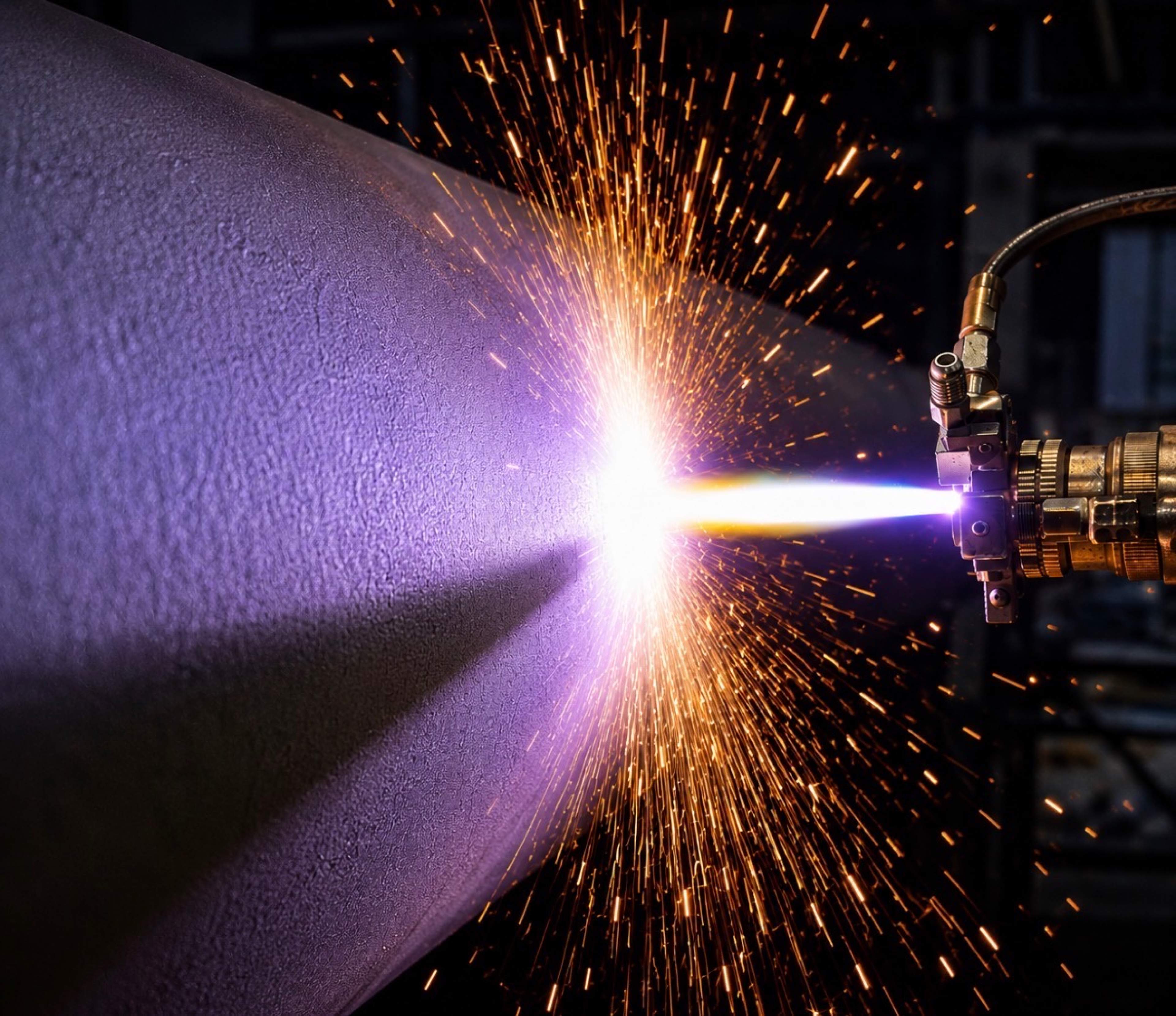
The plasma spraying process, shown here, is a common method for applying ceramic coatings.