July 28, 2026Power Plant Fan Blade Rebuild: Fixing Erosion Before It Costs You an Outage
By Nolan Watson, Technical Writer at HFW Industries
Induced draft and forced draft fan blades erode. Fly ash and unburnt particulate in the flue gas wear the blades down over years of service. The leading edge takes the brunt of it, coatings wear thinner, and eventually a blade that started life at full dimension shows up on an inspection report as a candidate for replacement.
At coal-fired plants, induced draft fan blades may last a few years before eroding badly enough to need replacement, and that service life shrinks further as upstream fly ash collection equipment ages. As the leading edge coating erodes, chlorides and sulfur in the flue gas add pitting corrosion on top of that. Once the coating is gone, the base metal takes the abuse directly.
Reliability, maintenance, and planning teams face a choice every time a fan comes up for inspection: replace the blade, or rebuild it and get it back in service at a fraction of the cost and lead time.
HFW Rebuilds Blades In One Facility, Start to Finish
HFW Industries has worked on precision industrial equipment for power generation for more than 75 years, and blades are one of the components we handle regularly. Every step of the rebuild, from surface prep through final balance, happens in one ISO 9001:2015 certified facility. There is no shipping a blade to one shop for welding and another for coating. One team, one quality system, and one point of accountability for the finished part.
That matters particularly for blades. Each blade that comes through the shop carries a different wear pattern, a different amount of missing material, and possibly a different history of prior coatings. Fixing it right takes an engineering team that looks at the actual condition of the part and adjusts the rebuild to match it.
What Blade Rebuild Actually Looks Like
Here is the sequence a worn blade goes through at HFW, from the time it arrives to the time it ships back to the customer.
Blasting
The blade is blasted to strip rust, buildup, and any prior coating down to base material. This also roughens the surface, which increases surface area and gives the thermal spray coating a stronger mechanical bond later in the process.
Welding
Power generation equipment runs in punishing conditions, and blades often arrive severely worn. Welding rebuilds the blade surface, adding material back to reestablish its original shape and dimensions. This step, along with the grinding that follows it, is typically the largest part of the job, and it is highly custom work. No two blades need the same amount of weld.
Hand grinding
After welding restores the shape, the welds are ground down by hand until they are flush with the rest of the blade surface. It is slow, detail-driven work, and it has to be right before the blade moves on to coating.
Thermal spray
The coating process depends on the blade and the environment it runs in. On many jobs, HFW uses a robot to apply HVOF coatings. This coating is only a few thousandths of an inch thick and still holds up under years of erosive, corrosive service. On others, stainless steel is applied via electric arc metallizing for wear and corrosion resistance. HFW's engineering team selects the process and material based on the specific application, matching the coating to how and where the blade actually operates.
Hub cleaning
The hub is cleaned to remove blemishes and make sure the blade fits precisely when it goes back into the assembly.
Balancing
As the final step, each blade is balanced to the customer's specification, since it is going back into service as part of a larger rotating assembly where imbalance has consequences well beyond the blade itself.
One Source Instead of Five Vendors
Pure-play coating shops can apply a thermal spray coating. What they generally cannot do is weld a blade back to its original dimensions, hand grind it to tolerance, coat it, clean the hub, and balance it, all without sending the part somewhere else for one or more of those steps. Every handoff between vendors adds lead time, adds a point where tolerance stacks up, and adds a vendor who did not see the blade before this stage of the process.
HFW's turnkey model is built to remove those handoffs. Blasting, welding, grinding, thermal spray, hub cleaning, and balancing all happen in one facility, backed by an ISO 9001:2015 quality system that tracks the part through every stage.
Coating a blade well starts before the spray gun ever comes out. HFW's engineering team looks at the actual operating environment, temperature, particulate load, and corrosion profile, and matches the coating and process to it on a job-by-job basis.
Contact HFW About Power Plant Fan Blade Rebuild
If you have machinery scheduled for rebuild, an upcoming outage, or questions about fan blade rebuild, send us your drawing, photos, operating conditions, or failed component details. Our team can review the application as well as coating and rebuild/manufacture options.
To discuss your application, email RFQ@hfwindustries.com. Submit a quote request with drawings, photos, operating conditions, and timing so HFW can review the application and next steps. You can also call (716) 875-3380.
Let’s keep your equipment running and your schedule reliable.
Additional Technical Resources for Power Generation Teams
Sign up for our newsletter and explore these resources from our Knowledge Base:
- Overview of Thermal Spray Coatings: HVOF & Tungsten Carbide — Why these materials are key to high-performance surface protection
- How Does HFW Serve the Turbomachinery Industry? — Learn about HFW's one-source repair and manufacturing strategy for turbines, rotors, and other turbomachinery equipment
- Turbo-Compression Repair and Turbomachinery Coating Services — Receive a complete look at HFW’s turbo-compression repair capabilities, from HVOF coatings and hardfacing to precision grinding, and EMRO inspection
- Steam Turbine Repair — Learn about HFW's steam turbine repair services for valves, rotors, shafts, and blades, backed by a documented case where controlled hardfacing stopped delamination for at least five years.
- Generator Shaft Repair: HVOF Coatings & Machining — Understand how a rebuilt generator shaft can outperform the original with engineered surface coatings, precision machining, and precision grinding/finishing
- Hard Chrome Plating Alternatives — See why HVOF is the proven replacement as tightening regulations are accelerating the move away from hard chrome plating
Fan Blade Rebuild FAQ
Can a worn fan blade be rebuilt instead of replaced?
Yes. Blades with wear, missing material, or coating loss can typically be rebuilt rather than replaced, as long as the base material is sound enough to weld back to spec.
What coating goes on a rebuilt fan blade?
The coating depends on the operating environment. HFW applies HVOF coatings using robotic application for many jobs, and electric arc metallizing with stainless steel for others. The engineering team selects the process and material based on the blade's actual service conditions.
What does fan blade rebuild involve, start to finish?
At HFW, a worn blade goes through blasting to strip it to base material, welding to rebuild missing material and restore its original dimensions, hand grinding to bring the welds flush, thermal spray coating, hub cleaning, and final balancing before it ships back to the customer.
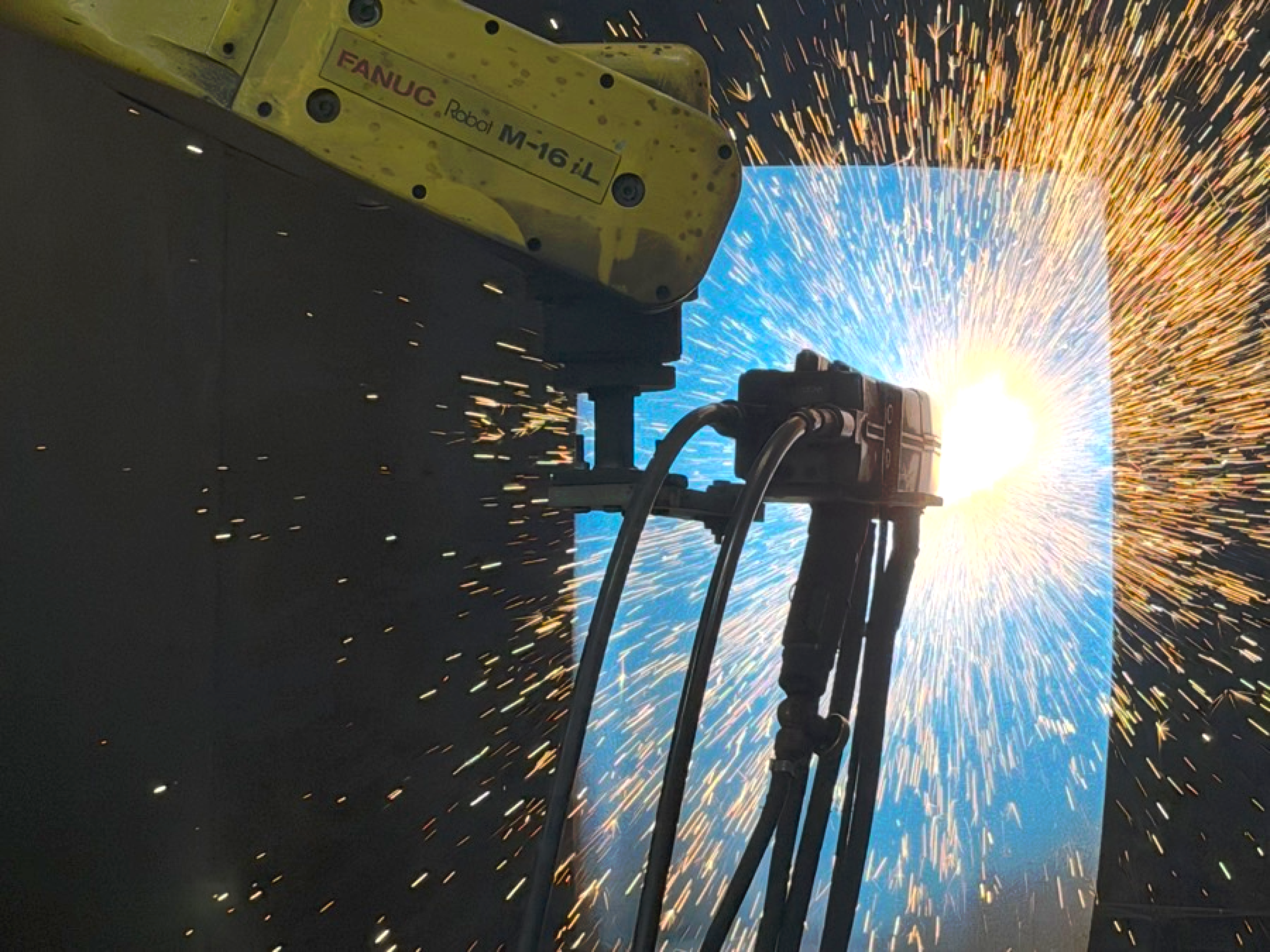
Applying stainless steel coating to a power plant blade via electric arc metallizing.